







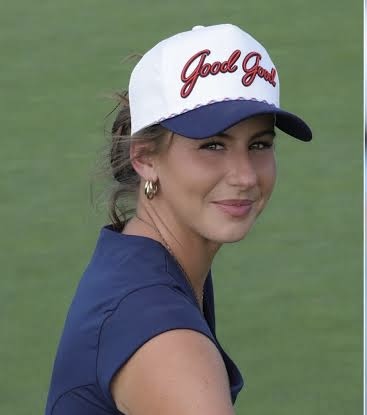
Alexis Miestowski has found herself at the center of one of the biggest controversies to hit the online golf world after appearing in a Good Good Golf advertisement that sparked widespread criticism over its depiction of violence against women.
The advertisement, created to promote a new Good Good and Callaway driver, showed Good Good co-founder Garrett Clark rushing toward Miestowski after she reached for the golf club. Clark then appeared to shove her to the ground before warning her not to touch his new driver. The short promotional video was quickly removed after viewers reacted angrily across social media.
The backlash was immediate, with critics arguing that the advertisement crossed a serious line by using an image of a man physically overpowering a woman as part of a joke to sell a golf product.
Miestowski at the center of the controversy
Miestowski was not simply an actress brought in for the commercial. She is a creator associated with Good Good and a former Division I golfer, making her an established figure within the golf-content space.
Her involvement in the advertisement placed her in an uncomfortable position as the controversy grew. While the online discussion largely focused on Clark, Good Good and Callaway, Miestowski’s role in the video also became a major talking point among fans and critics.
The controversy became even more intense because the advertisement was released at a time when women’s participation in golf has been growing rapidly. Critics argued that portraying a female golfer being shoved to the ground was particularly inappropriate for a brand that has repeatedly promoted making golf more accessible and inclusive.
Good Good apologizes
Following the backlash, Good Good removed the advertisement and apologized.
The company acknowledged that the video depicted actions that did not align with its values and said it remained committed to making golf more inclusive.
Clark later issued his own lengthy apology, accepting responsibility for his role in the advertisement. He described the concept as a bad idea and said the reaction made him realize how poorly the concept had been judged. He also explained that the scene was intended to be a parody inspired by the horror movie Obsession.
Clark also addressed online harassment surrounding the controversy and defended Miestowski, emphasizing that she should not be blamed for the situation.
Callaway also faces criticism
The controversy quickly expanded beyond Good Good.
Callaway, which collaborated with Good Good on the driver, initially expressed disappointment over the advertisement. The company later acknowledged that the commercial had been approved internally, admitting that the approval should never have happened.
Callaway ultimately ended its relationship with Good Good and announced a $1 million commitment to organizations working to combat violence against women.
That decision represented a dramatic change from the company’s initial response and demonstrated just how serious the backlash had become.
The fallout gets bigger
The consequences did not stop with the end of the Callaway partnership.
Major retailers, including Dick’s Sporting Goods and Golf Galaxy, pulled Good Good products following the controversy. The Golf Channel also canceled its planned Big Break x Good Good project.
Good Good also withdrew as title sponsor of an upcoming PGA Tour event in Austin, Texas. The tournament is expected to continue under a different name and sponsorship arrangement.
The situation has therefore evolved from criticism of a single advertisement into a major business and reputation crisis for the golf-content company.
A controversy that goes beyond one advertisement
What initially appeared to be a short promotional video has raised much broader questions about how brands and creators approach controversial humor.
For critics, the central issue was not whether the scene was scripted or whether the people involved understood that they were making a commercial. Instead, the criticism focused on the decision to use an image of a man knocking a woman to the ground as entertainment in the first place.
The fact that both Good Good and Callaway ultimately apologized and took significant action demonstrates how seriously the companies have been forced to treat the backlash.
Meanwhile, Good Good CEO Matt Kendrick has taken a more confrontational approach toward Callaway, arguing that the equipment company had approved the advertisement before the backlash and later shifted responsibility toward Good Good. He has even raised the possibility of legal action.
Miestowski’s position
For Miestowski, the controversy is considerably more personal than a normal advertising mistake.
She became the face of a controversial scene that she did not control, while the debate surrounding the advertisement spread across social media and the golf community.
As the controversy continues to develop, attention has increasingly turned toward her perspective and how she experienced the situation.
Her involvement has also highlighted an uncomfortable reality of influencer-driven sports media: creators can quickly become part of major commercial campaigns, but when those campaigns go wrong, the people appearing on camera can face intense public scrutiny alongside the companies responsible for producing and approving the content.
The Good Good controversy is therefore no longer simply about a golf driver or a deleted advertisement. It has become a debate about responsibility, marketing judgment, gender representation and the consequences brands face when an attempt at provocative humor goes too far.
For now, Good Good is attempting to navigate the fallout, while Callaway has completely separated itself from the partnership. Miestowski, meanwhile, remains at the center of the story because of the role she played in the advertisement that started it all.
One important note: I could verify extensive reporting about the controversy and statements from Good Good, Garrett Clark and Callaway, but I could not independently verify a public emotional statement from Alexis Miestowski herself in the sources available right now. So I would avoid presenting specific words or feelings as hers unless you have the original post/video.