








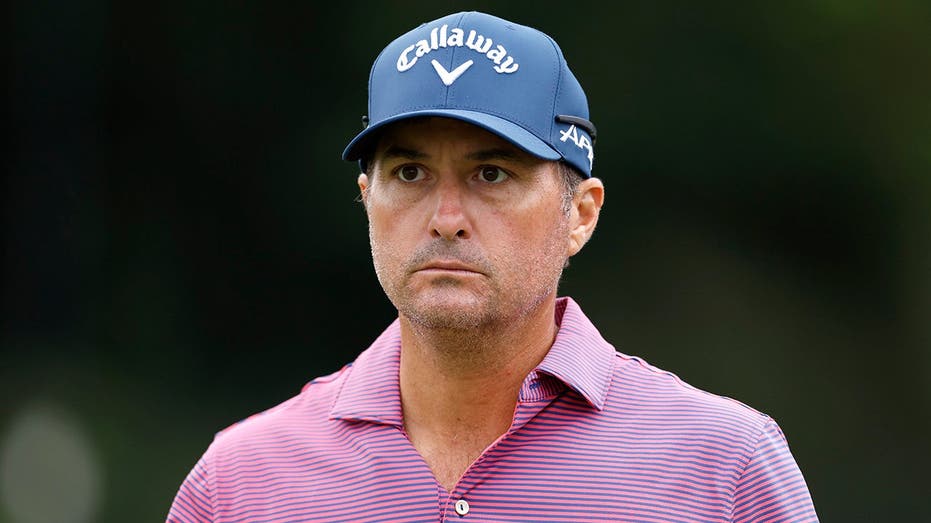
Rory McIlroy has responded to Kevin Kisner after the American golfer questioned his motives for competing in the DP World India Championship, sparking a heated debate about appearance fees, professional golf and the genuine desire to grow the sport globally.
The Northern Irishman found himself at the centre of the controversy after Kisner openly criticised his explanation for travelling to India to compete in the tournament. McIlroy had spoken about his interest in helping golf reach new audiences, particularly in a country with enormous potential for the sport. However, Kisner was far from convinced by that explanation.
Speaking on the Fore Play podcast, Kisner described McIlroy’s comments as a “dogs— comment” and suggested that the real motivation behind his participation was the substantial appearance fee he believed the golfer was receiving.
His remarks quickly attracted attention, raising questions about whether elite golfers participate in international tournaments because of their commitment to expanding the game or because the financial rewards make the trip worthwhile.
McIlroy has now delivered his response, making it clear that receiving payment to participate in a tournament does not automatically mean that a player’s interest in growing the sport is insincere.
KEVIN KISNER QUESTIONS RORY MCILROY’S MOTIVES
The controversy began after McIlroy expressed his enthusiasm about returning to India for the DP World India Championship.
The Masters champion had previously spoken positively about his experience in the country, highlighting the warm reception he received from golf fans and his interest in being part of efforts to introduce the sport to a wider audience.
For McIlroy, the opportunity represented more than simply another tournament on his schedule. India has a large population and a growing middle class, making it an attractive potential market for golf as organisers look to expand the sport beyond its traditional strongholds.
Kisner, however, questioned whether those ambitions were the real reason behind McIlroy’s decision.
The American suggested that the Northern Irishman was primarily motivated by a reported appearance fee that could reach $10 million, although that figure has not been publicly confirmed.
“That is such a dogs— comment,” Kisner said while discussing McIlroy’s explanation on the podcast.
He went further by suggesting that McIlroy was not travelling to India because he genuinely wanted to expand golf’s international reach, but rather to collect the money associated with his appearance.
Kisner also questioned why a player of McIlroy’s calibre would choose to compete on a course that did not necessarily suit his greatest strengths.
His criticism was direct, and it quickly turned what might otherwise have been a routine discussion about tournament participation into a broader debate about the commercial side of professional golf.
MCILROY DELIVERS HIS RESPONSE
McIlroy was subsequently asked about Kisner’s comments following the conclusion of the tournament.
The four-time major champion indicated that he had not seen the remarks beforehand and questioned why his decision to compete in India had attracted such criticism.
Rather than engaging in a prolonged personal dispute, McIlroy offered a response that addressed the central issue raised by Kisner.
“I don’t know why me being in India would make Kis need to comment on that,” McIlroy said.
He then explained his position, making the argument that financial compensation and a genuine interest in promoting golf internationally are not mutually exclusive.
“Two things can be true at the same time,” he added.
McIlroy’s response was significant because it challenged the assumption underlying Kisner’s criticism.
In his view, professional golfers can receive appearance fees while also believing that their participation can help introduce the sport to new audiences.
The Northern Irishman also highlighted India’s potential as a market for golf, pointing to the country’s expanding middle class and the opportunities that could emerge as the sport reaches more people.
He described India as a developing country with a huge potential audience, arguing that its size and economic growth make it an important destination for golf’s international expansion.
Rather than denying the commercial realities of professional golf, McIlroy focused on the possibility that financial incentives and broader sporting ambitions can exist together.
THE REPORTED $10 MILLION APPEARANCE FEE EXPLAINED
One of the biggest talking points surrounding the dispute is the reported appearance fee that Kisner believes McIlroy received to compete in India.
Appearance fees are payments made to attract prominent players to tournaments. They can be an important part of efforts to secure star participation, particularly at events seeking greater international attention.
For tournament organisers, attracting a player of McIlroy’s stature can provide significant publicity, encourage fan interest and help raise the profile of an event in a competitive sporting market.
However, these arrangements can also attract criticism, particularly when the reported payment appears significantly larger than the prize money available to the tournament’s winner.
Kisner’s comments centred on that issue, with the American suggesting that a substantial financial incentive was the main reason McIlroy agreed to compete.
It is important to distinguish between his allegation and confirmed information. The reported $10 million figure has not been publicly established as McIlroy’s actual appearance fee.
Nevertheless, the suggestion became a major part of the controversy, prompting renewed discussion about how professional golf attracts its biggest names to tournaments around the world.
McIlroy did not provide a publicly confirmed figure for his compensation in his response. Instead, he focused on the broader principle that being paid to participate does not necessarily invalidate a player’s stated interest in helping the game grow.
That distinction lies at the heart of the disagreement between the two golfers.
KISNER ALSO QUESTIONS THE TOURNAMENT’S APPEAL
Beyond the financial allegations, Kisner questioned the sporting appeal of the DP World India Championship for a player such as McIlroy.
The American pointed out that Delhi Golf Club presents a different challenge from the courses where McIlroy’s powerful driving is often a major advantage.
The course’s tight layout and demanding holes can place a greater emphasis on accuracy and positioning than outright distance.
Kisner argued that the tournament’s playing conditions made McIlroy’s decision to participate even more difficult to understand without a substantial financial incentive.
He questioned why the Northern Irishman would choose an event where he could not fully exploit one of the strongest aspects of his game.
His comments reflected a wider debate about how elite golfers select their schedules.
Top players must balance competitive priorities, personal commitments, sponsorship obligations and the demands of travelling internationally. Their decisions are not always based solely on which course best suits their playing style.
For McIlroy, the India event also presented an opportunity to compete in a different environment and contribute to the visibility of professional golf in a potentially important market.
Whether the tournament represented an ideal competitive fit was separate from the question of whether his participation could benefit the sport.
TOMMY FLEETWOOD AND JUSTIN ROSE ALSO DRAW ATTENTION
McIlroy was not the only prominent golfer whose participation attracted attention.
Tommy Fleetwood and Justin Rose were also among the high-profile players competing at the event, with reports indicating that they were receiving appearance fees as well.
Their involvement highlighted the broader commercial strategy behind attracting established international stars to tournaments outside the sport’s traditional centres of attention.
When several recognisable players compete at the same event, organisers can create a stronger promotional platform and attract interest from fans who might otherwise have little connection to the tournament.
The players may also be expected to participate in promotional activities alongside their competitive commitments.
That combination of sport and marketing is a familiar feature of professional golf, where sponsors and organisers invest heavily in building the profile of tournaments.
Kisner questioned the messaging associated with these appearances, suggesting that players were encouraged to repeat prepared statements about expanding the game while fulfilling their promotional obligations.
He indicated that he would also accept such an arrangement himself, adding that he understood why players would take part in events offering significant financial rewards.
His criticism, therefore, was not simply about the existence of appearance fees. It was also about whether the public explanations given for participating accurately reflected the players’ motivations.
IS IT POSSIBLE TO GROW GOLF WHILE EARNING MILLIONS?
The disagreement between McIlroy and Kisner raises a question that extends beyond this particular tournament.
Professional sport operates within a commercial environment. Players earn money through prize funds, sponsorship agreements, endorsements and other arrangements designed to reward their performance and public appeal.
At the same time, sports organisations regularly invest in initiatives intended to introduce their games to new audiences.
Those objectives are not necessarily in conflict.
A tournament can offer a player substantial financial compensation while also generating publicity, inspiring young athletes and encouraging greater participation in a country where golf has room to grow.
The presence of internationally recognised golfers can make a tournament more attractive to broadcasters, sponsors and spectators.
For a developing golf market, the opportunity to watch major champions compete in person may also help strengthen interest in the sport.
However, questions about motivation are more difficult to answer because financial arrangements and personal intentions are not always publicly visible.
Kisner’s argument was that McIlroy’s explanation placed too much emphasis on growing the sport when money was, in his view, the real motivation.
McIlroy’s response was that both financial compensation and a genuine interest in international growth can exist simultaneously.
Neither argument changes the commercial reality of professional golf, but the exchange highlights the different ways players and observers interpret the relationship between money and sporting ambition.
MCILROY’S DECISION COMES AT AN IMPORTANT STAGE OF HIS CAREER
McIlroy’s participation in India also comes during a period in which his tournament schedule and priorities have attracted attention.
Following his historic Masters triumph in 2025, which completed the career Grand Slam, the Northern Irishman has had greater freedom to be selective about the events he plays.
Completing the Grand Slam was a defining achievement, placing him among a small group of golfers who have won all four men’s major championships during their careers.
With that milestone achieved, decisions about his schedule can involve a wider range of considerations, including family time, commercial opportunities and the tournaments he finds most appealing.
His appearance in India therefore became a talking point partly because fans and commentators were interested in understanding why he had chosen that particular event.
Kisner interpreted the decision primarily through a financial lens.
McIlroy, meanwhile, defended the possibility that playing in India could have value beyond the immediate competitive and financial rewards.
The discussion also demonstrates how decisions by the sport’s biggest stars can attract scrutiny, especially when those decisions intersect with broader questions about the future of professional golf.
A DISAPPOINTING FINISH DOES NOT END THE DEBATE
McIlroy finished in a tie for 42nd place at the DP World India Championship, meaning the event did not produce the competitive result he would have wanted.
However, his finishing position does not resolve the disagreement over why he chose to participate.
The debate centres on motivation, not simply performance.
A player can finish outside contention and still contribute to a tournament’s visibility. Equally, participating in an international event does not automatically guarantee that the tournament will transform the sport’s popularity in that country.
The long-term impact depends on several factors, including local facilities, access to coaching, opportunities for young players and continued investment in the sport.
McIlroy’s argument focused on India’s potential and the value of bringing prominent players to a market with significant room for growth.
Kisner’s criticism focused on the financial incentives and what he perceived as a gap between the stated purpose of the appearance and the likely reasons behind it.
Those are different questions, and McIlroy’s final position was that the two motivations need not cancel each other out.
THE CONTROVERSY PUTS PROFESSIONAL GOLF’S COMMERCIAL SIDE IN THE SPOTLIGHT
The exchange has once again highlighted the complicated relationship between professional golfers, tournament organisers and the sponsors who help finance the sport.
For tournament organisers, securing appearances from major champions can be an important investment. The presence of globally recognised players can help attract audiences, increase media coverage and raise a tournament’s international profile.
For the players, those appearances can create additional income and opportunities to strengthen commercial partnerships.
For fans, however, the central question is often whether players genuinely value the events they choose to enter or whether financial arrangements are doing most of the work.
Kisner’s comments tapped directly into that debate, while McIlroy’s response challenged the idea that a commercial incentive automatically makes a player’s stated intentions meaningless.
The discussion may continue as golf seeks to expand into new markets and tournaments compete to attract the biggest names in the sport.
Ultimately, the success of those efforts will be measured not only by the appearance of famous golfers but also by whether interest in the sport continues after the stars have left.
FINAL WORD
Rory McIlroy’s response to Kevin Kisner was clear: receiving payment to compete in a tournament does not mean a golfer cannot genuinely want to help expand the sport.
Kisner questioned McIlroy’s explanation for competing in India, arguing that a reported multimillion-dollar appearance fee was the more convincing reason for his participation. McIlroy countered that financial rewards and an interest in growing golf can coexist.
The disagreement has generated attention because it touches on a fundamental question about modern professional sport: can commercial interests and genuine sporting ambitions work together?
McIlroy believes they can. Kisner has openly questioned whether that explanation tells the whole story.
For now, the exchange has put both golfers’ views in the spotlight and reignited discussion about the money, motivations and international ambitions shaping professional golf.