







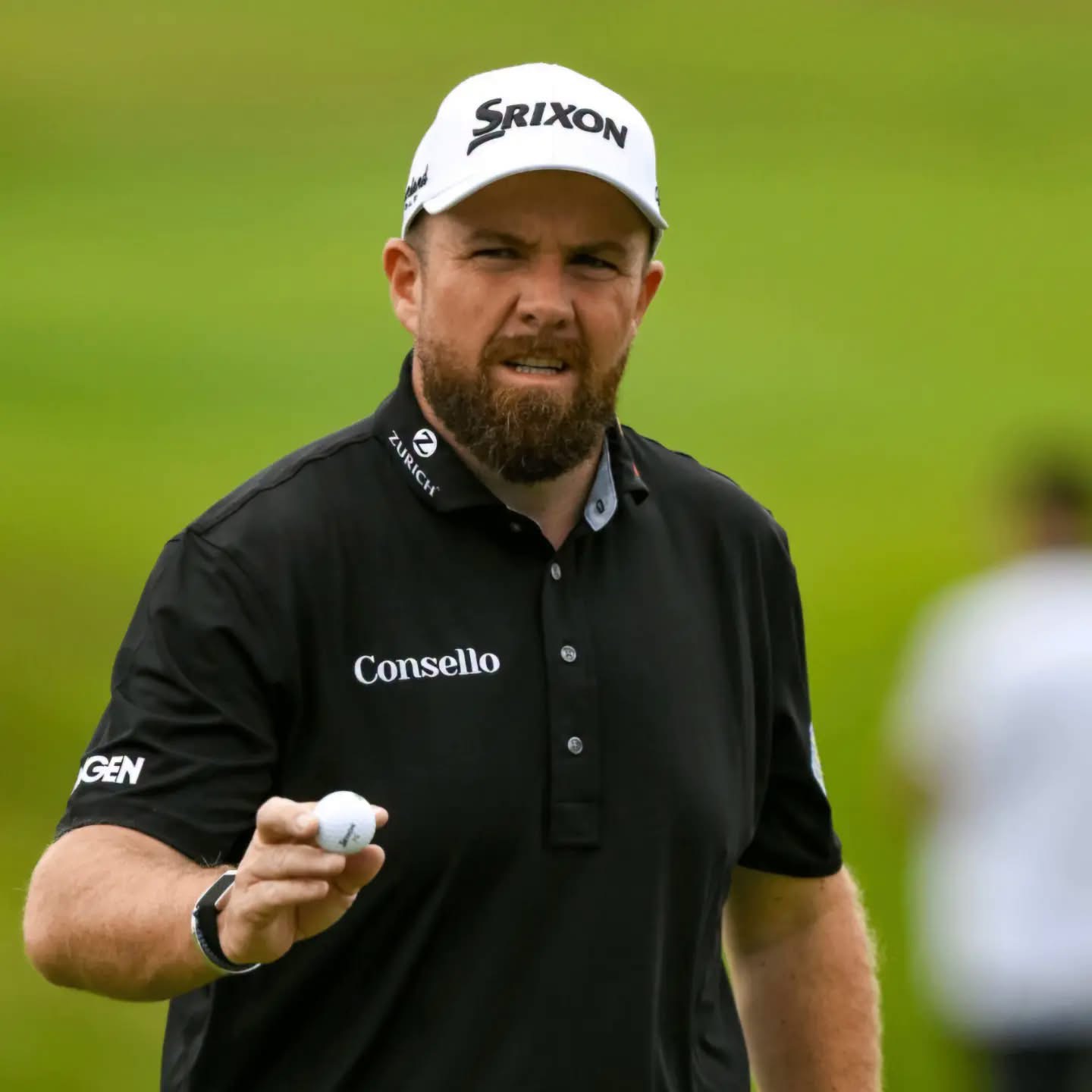
Shane Lowry may have celebrated one of the biggest victories of his career at the Irish Open, but a significant portion of his huge prize money could eventually disappear to taxes.
Lowry produced a remarkable performance at Trump International Golf Links in Doonbeg, finishing the tournament at 23 under par and winning by an incredible 11 shots.
The Irishman collected a winner’s prize of $1.02 million from the tournament’s $6 million purse after completing one of the most dominant Irish Open performances in history.
However, while the headline figure is an impressive $1.02 million, the amount Lowry ultimately keeps will be considerably lower once his tax obligations are taken into account.
A rough estimate puts the potential tax and related deductions at around $350,000, meaning Lowry could be left with somewhere around $670,000 after the estimated deductions.
It is important to stress that the $350,000 figure is only an estimate. Lowry’s actual tax bill has not been publicly disclosed and cannot be calculated precisely without knowing his complete financial and tax circumstances.
Ireland’s tax system is also more complicated than simply taking a fixed percentage from the prize.
The Irish Revenue system has specific rules for professional sportspersons. Sportsperson’s Relief can allow qualifying athletes to deduct 40 percent of certain income earned directly from participating in their sport, including prize money. However, the relief is designed for sportspersons who have retired from their profession, meaning it is not something that can simply be assumed to apply immediately to an active golfer like Lowry.
Income Tax is generally charged at different rates depending on the person’s taxable income, with the higher rate applying above the relevant income band. For 2026, the standard income tax rate is 20 percent up to the applicable band, with income above that band generally taxed at 40 percent.
Lowry’s situation is therefore much more complicated than simply saying that he lost 40 percent of his Irish Open winnings.
His total income for the year, expenses, residency, tax arrangements and other sources of earnings would all have an impact on his final liability.
There can also be other charges beyond Income Tax, including Universal Social Charge and Pay Related Social Insurance, depending on how the income is treated.
That is why the estimated $350,000 figure should be viewed as an indication of what could potentially leave the prize rather than a confirmed tax payment.
Still, even after a substantial deduction, Lowry’s Irish Open victory represents a huge financial payday.
The $1.02 million prize is the largest single piece of the tournament’s $6 million purse, and Lowry earned it after producing four outstanding rounds.
He opened with a 67 before following it with a sensational 62, which set a new course record at Doonbeg.
He then carded a 65 in the third round before closing with another seven under par 63.
That gave him a four round total of 257 and placed him 23 under par for the tournament.
The final round was particularly impressive because Lowry entered Sunday with a four shot advantage but did not allow the pressure of a home Irish Open to affect him.
Instead, he continued attacking the course and eventually turned the tournament into a procession.
Patrick Reed and Joaquin Niemann finished tied for second, but both were left a staggering 11 shots behind the champion.
The margin also broke the previous Irish Open record for the largest winning margin.
Lowry’s victory was his second Irish Open title, coming 17 years after he famously won the tournament as an amateur in 2009.
That made the achievement even more special, particularly because he was able to complete it in front of a home crowd.
Donald Trump was also present for the final round and later presented Lowry with the trophy at the conclusion of the tournament.
Lowry’s victory came after a difficult period in which he had struggled to convert strong performances into another individual title.
The Irish Open finally gave him the breakthrough he had been waiting for.
Financially, the victory also represents a major boost.
Even after a potential tax bill running into hundreds of thousands of dollars, a prize of $1.02 million remains a significant addition to his season’s earnings.
And the money was not the only reward.
Lowry also collected valuable Race to Dubai points and Ryder Cup qualification points following his victory.
For now, the exact amount Lowry will eventually hand over in tax remains unknown.
What is certain is that the Irishman walked away from Doonbeg with more than $1 million in gross prize money after producing one of the greatest performances in Irish Open history.
The $350,000 figure may grab the headlines, but the bigger story is that Lowry finally delivered a spectacular home victory, broke records and lifted the Irish Open trophy once again.
He won by 11 shots.
He finished 23 under par.
And he collected a $1.02 million winner’s cheque.
Whatever the final tax bill turns out to be, Shane Lowry’s Irish Open triumph was undoubtedly worth celebrating.