




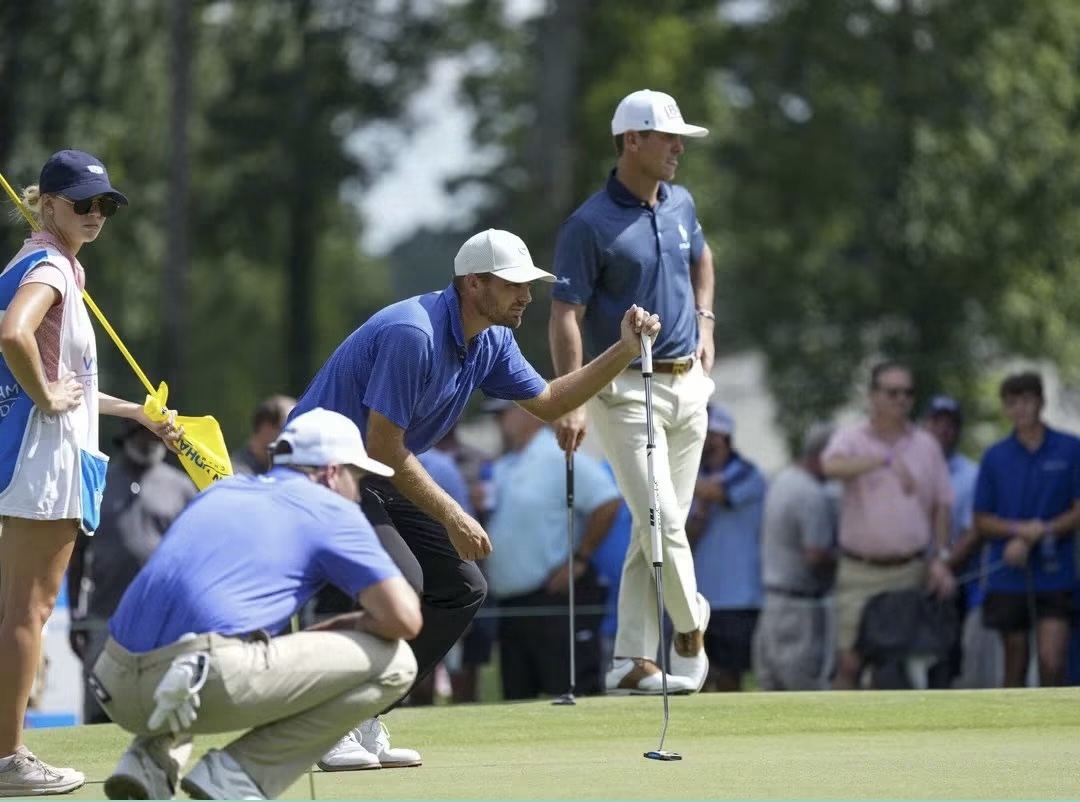
A routine weather delay turned into a tournament-ending nightmare for Aaron Wise at the Wyndham Championship after the PGA Tour golfer was disqualified for failing to return to the course when play resumed.
What initially appeared to be nothing more than another interruption caused by dangerous weather ultimately became one of the most unusual stories of the tournament. Wise had only a handful of holes remaining in his second round when play was suspended, but his decision not to return after the delay resulted in a violation serious enough to bring his week to an immediate end.
The incident highlighted just how strict the rules of professional golf can be, particularly when a tournament committee orders players back onto the course.
Weather delay interrupts play
The Wyndham Championship, the final regular-season event on the PGA Tour schedule, was already carrying significant importance for players across the field.
With the FedExCup Playoffs approaching, golfers were battling for valuable points, playoff positions and, for some, their PGA Tour status. Every opportunity to gain ground mattered.
But the weather had other plans.
Play was suspended at Sedgefield Country Club in Greensboro, North Carolina, after dangerous weather moved into the area. The suspension began at approximately 5:26 p.m. local time.
The stoppage, however, did not last particularly long.
Officials were able to resume play at around 6 p.m., meaning the players still on the course were expected to return to their positions and continue their rounds.
Most did.
Wise did not.
That decision ultimately cost him his tournament.
Wise had four holes left
At the time of the suspension, Wise had already played 14 holes of his second round.
He had started his round on the back nine and was sitting at one over par for the day when the weather interruption occurred.
His overall position was already difficult.
After opening the tournament with a two-over 72, Wise entered the second round needing a strong performance to remain in contention to make the weekend.
Instead, his second round had produced an inconsistent mixture of birdies and bogeys.
He had recorded three birdies but also four bogeys, leaving him three over par for the tournament with four holes still to play.
The projected cut was significantly lower, meaning Wise faced an uphill battle to qualify for the weekend.
Still, the tournament was not technically over.
He had four holes remaining, and under normal circumstances he would have been expected to return once play resumed and complete them.
That did not happen.
An unusual rule breach
The reason for Wise’s disqualification was connected to Rule 5.7, which deals with suspensions and resumptions of play.
When the tournament committee suspends play, players are required to follow the instructions regarding when and where they must resume.
Once officials announce that play has restarted, players must be ready to continue from the location where play was stopped.
In Wise’s case, he was not in position when play resumed.
That alone created a serious problem.
Reports indicated that tournament officials had not been informed that Wise would not be returning to the course.
Under the rules, failing to resume play when required can result in disqualification.
That was ultimately the punishment handed down to Wise.
Rather than simply being recorded as an incomplete round or being allowed to withdraw, he was officially disqualified from the Wyndham Championship.
Why the incident is so unusual
Golf fans are accustomed to seeing players receive penalties for actions that happen during competition.
A golfer can be penalized for hitting the wrong ball, taking an incorrect drop, signing an incorrect scorecard or breaching equipment regulations.
Wise’s situation was different.
His tournament ended because he was not ready to resume after a weather suspension.
There was no controversial shot.
There was no disputed putt.
There was no equipment issue.
Instead, the decisive moment happened away from the action itself.
That makes the incident particularly unusual.
Professional golfers are expected to remain aware of tournament announcements and their responsibilities during suspensions. Once officials announce that play has resumed, players must be prepared to return to the course.
The rules do not change simply because a player is struggling or believes there is little chance of making the cut.
His position on the leaderboard did not matter
One of the most important aspects of the situation is that Wise’s poor position in the tournament did not exempt him from the rules.
By the time the suspension occurred, he was already well outside the projected cut line.
It may have seemed unlikely that completing four more holes would change his situation dramatically.
But that does not give a player permission to stop playing before the tournament committee has officially released him from his obligation.
Whether a player is leading by five shots or sitting near the bottom of the leaderboard, the same rules apply.
Once play resumes, players must be ready.
That principle is particularly important during professional tournaments because allowing one player to ignore the restart could create inconsistencies across the field.
A difficult season gets another setback
The disqualification came during what has been a challenging season for Wise.
The 30-year-old entered the Wyndham Championship ranked 149th in the FedExCup standings.
That position left him well outside the top 70 required to qualify for the FedExCup Playoffs.
His season had already been difficult, including a run of missed cuts early in the campaign.
Although he managed to find some better form at different points, consistency remained a major issue.
The Wyndham Championship therefore represented an opportunity to finish the regular season on a stronger note.
Instead, Wise left the tournament without a finishing position.
His week ended in circumstances that few players would ever want to experience.
Wise is no stranger to the PGA Tour
The incident is even more surprising because Wise is an experienced PGA Tour player.
He became a Tour winner in 2018 when he claimed the AT&T Byron Nelson.
That victory helped establish him as one of the promising young players on the PGA Tour.
Since then, his career has gone through various highs and lows.
He has experienced the pressure of competing against the world’s best