







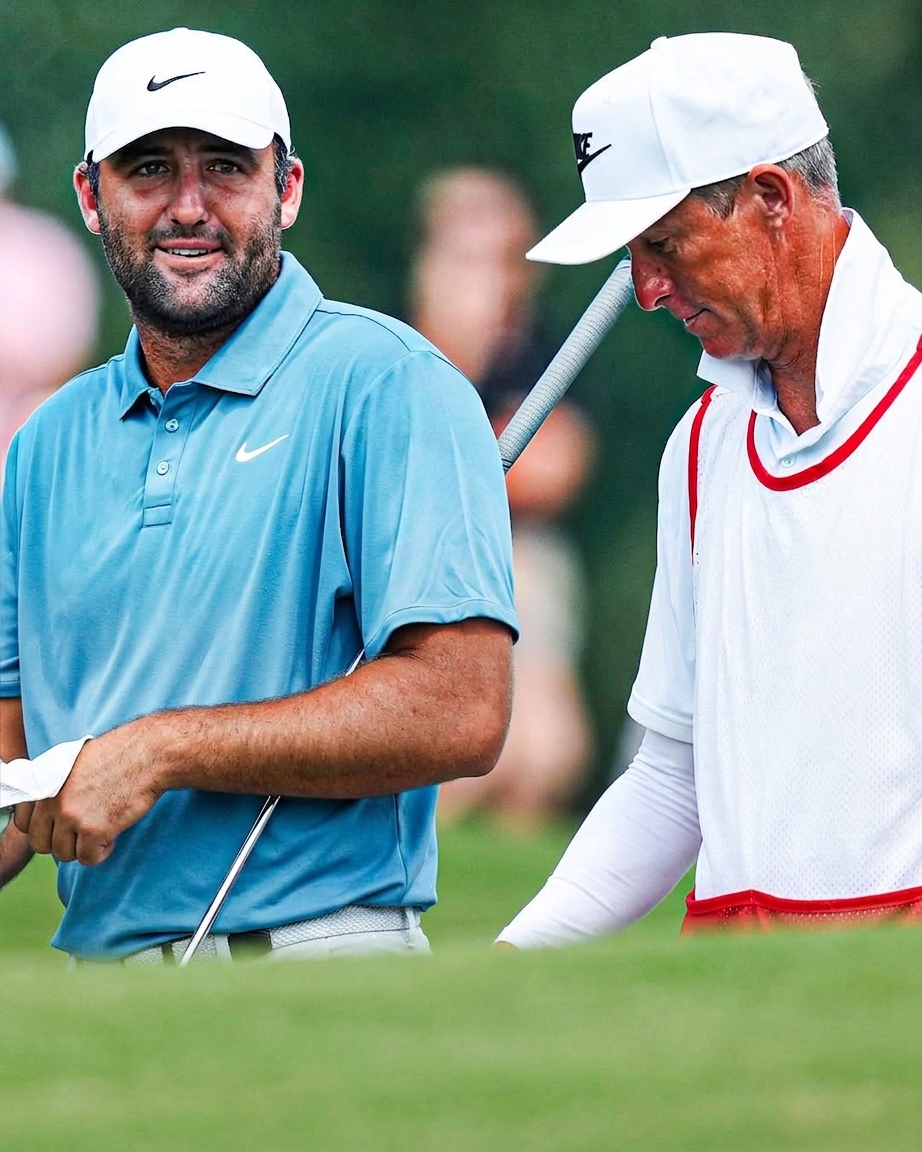
Scottie Scheffler’s longtime caddie, Ted Scott, has shared a revealing story about the world-class golfer’s attitude toward money and competition, offering insight into why the four-time major champion never seriously considered joining LIV Golf.
Scott’s comments have attracted attention amid growing uncertainty surrounding LIV Golf’s future, with the breakaway league facing major financial challenges and several prominent players reconsidering their commitments.
During an appearance on The Gravy & Sleeze podcast, Scott recalled a conversation he had with Scheffler during LIV Golf’s recruitment drive in 2022. According to the veteran caddie, Scheffler made it clear that no financial offer would persuade him to abandon the PGA Tour if doing so meant missing the opportunity to compete against the world’s best golfers.
The revelation offers a glimpse into the competitive mentality that has helped Scheffler establish himself as one of the dominant figures in modern golf.
Ted Scott Reveals Why Scheffler Would Have Rejected LIV Golf
When LIV Golf began attracting some of the biggest names in professional golf, the league used enormous signing bonuses and lucrative contracts to persuade established stars to leave traditional tours.
Several major champions accepted those offers, changing the landscape of professional golf and intensifying the rivalry between LIV Golf and the PGA Tour.
However, according to Scott, Scheffler’s priorities were never primarily financial.
Scott recalled suggesting that LIV Golf could offer the American star approximately $250 million to join the breakaway circuit.
Scheffler’s response reportedly left his caddie impressed.
The world number one explained that he wanted to compete where the best players were gathered because his primary motivation was beating his opponents.
Scott said Scheffler would have maintained that position even if the offer had reached $1 billion.
The story highlights a different approach to professional golf, with Scheffler prioritizing competition over the prospect of securing an enormous guaranteed payment.
For a player who has become one of the sport’s most successful competitors, that mentality has helped define his career.
Why Scottie’s Decision Matters as LIV Golf Faces a Crisis
Scheffler’s reported refusal to join LIV Golf is particularly relevant now that the league is attempting to secure its long-term future.
Since its launch in 2022, LIV Golf has attracted numerous established players by offering substantial financial incentives, guaranteed contracts and a team-based format designed to appeal to a broader audience.
The league’s recruitment strategy significantly changed professional golf, prompting leading players to make difficult decisions about their careers.
However, LIV Golf has encountered serious financial difficulties following Saudi Arabia’s Public Investment Fund decision to withdraw its financial backing after the 2026 season.
The organization subsequently entered a court-supervised restructuring process while exploring new investment arrangements and plans for a possible 2027 relaunch.
The proposed new structure, known as LIV Golf 2.0, has faced uncertainty over player commitments, financing and the league’s future business model.
As of October 26, 2026, the organization is still working to determine whether it can secure enough support to continue operating in its proposed new form.
Against that backdrop, Scott’s account of Scheffler’s decision serves as a reminder that financial incentives alone do not determine every golfer’s career choices.
For some players, the opportunity to compete regularly against the strongest possible fields remains the most important consideration.
Scheffler Chose Competition Over Money
Scheffler’s career provides considerable context for Scott’s story.
The American has established himself as one of the leading players of his generation, winning multiple major championships and consistently competing at the highest level.
His success has also brought substantial financial rewards through tournament victories, performance bonuses and sponsorship opportunities.
Yet Scott’s account suggests that money was never the principal motivation behind Scheffler’s decision to remain on the PGA Tour.
The caddie recalled that even early in their working relationship, Scheffler was not particularly interested in equipment sponsorships if accepting them meant giving up the freedom to use the products he preferred.
That attitude, according to Scott, reflected a broader characteristic of Scheffler’s personality.
He wants to win.
Whether competing in a major championship, a regular PGA Tour event or even an informal game, Scheffler approaches competition with an intense desire to come out on top.
Scott believes that mindset is a major part of what makes the golfer so successful.
Rather than allowing financial considerations to dictate his decisions, Scheffler has continued to focus on improving his game and competing against the strongest opponents available.
His approach stands in contrast to the recruitment strategy LIV Golf employed when it launched, although players who joined the breakaway league have offered different reasons for making that decision.
LIV Golf’s Biggest Challenge Is No Longer Just Recruiting Players
When LIV Golf first emerged, its financial resources gave it a significant advantage in attracting established golfers.
The league successfully recruited major champions and internationally recognized names, including Bryson DeChambeau, Dustin Johnson, Brooks Koepka, Phil Mickelson and Jon Rahm.
Their arrivals gave the new circuit immediate credibility and intensified its competition with the PGA Tour.
However, LIV Golf’s current situation demonstrates that attracting star players is only one part of building a sustainable professional sports organization.
The league must also maintain financial stability, secure commercial partnerships, meet its contractual obligations and provide players with confidence in its future.
The withdrawal of its principal financial backer has forced LIV Golf to reconsider its operating model.
Its proposed relaunch would involve a different ownership and investment structure, with players potentially receiving a greater stake in the organization.
Nevertheless, questions remain over how the new arrangement would work and whether enough leading golfers will agree to participate.
Recent reports indicate that several prominent players are unwilling to commit to LIV Golf 2.0, while others are still considering their options.
The situation has placed additional pressure on the organization as it attempts to finalize its plans for 2027.
Could More LIV Golf Players Return to the PGA Tour?
The uncertainty surrounding LIV Golf has also renewed discussions about whether former PGA Tour members could eventually return.
Rory McIlroy has expressed support for welcoming some former LIV players back, while emphasizing that returning golfers should not expect an automatic or immediate reinstatement.
Scheffler has also acknowledged that some LIV players would add competitive value to the PGA Tour.
However, he has indicated that the organization must consider appropriate consequences for players who left, with the tour’s leadership responsible for determining the terms of any potential return.
These discussions have become increasingly important as LIV Golf players assess whether to remain with the league or seek opportunities elsewhere.
Leaving LIV Golf does not automatically restore PGA Tour membership. Any return would depend on the applicable eligibility requirements, membership status and reinstatement arrangements.
For golfers who have spent several years competing primarily on LIV Golf, the decisions could have significant implications for their careers.
At the same time, a return by leading players could help restore some of the competitive matchups that fans have missed since the division in professional golf began.
Whether the PGA Tour establishes a broader pathway for former members remains an important unanswered question.
What Ted Scott’s Comments Mean for Scottie Scheffler’s Future
Scott’s account does not represent an announcement that Scheffler is considering a change of tour.
Instead, it reinforces the position that the world number one has maintained throughout LIV Golf’s rise: his priority is competing against the best players in the world.
That approach has served him well, allowing him to build an outstanding record while remaining on the PGA Tour.
It also helps explain why he has not followed several other major champions to the Saudi-backed league, despite the substantial financial opportunities associated with joining.
For Scheffler, the appeal of professional golf appears to lie in the challenge of winning tournaments and measuring himself against the strongest competition available.
As LIV Golf attempts to rebuild, his decision represents an example of a different path to success in the sport.
The league may continue to attract players who value its financial arrangements, team format and international schedule. However, retaining the confidence of elite competitors will require more than lucrative contracts alone.
Players must also believe in the organization’s long-term stability and the competitive opportunities it provides.
With LIV Golf’s future still uncertain, Ted Scott’s revelation offers a fascinating look at why Scottie Scheffler chose to stay on the PGA Tour when other major champions accepted enormous offers to leave.
Do you think Scheffler made the right decision by staying on the PGA Tour, or should he have considered LIV Golf’s financial offers?